Death by a Thousand Prompts
A couple months ago, I decided to reverse engineer Notion, pixel for pixelClaude clicked through every feature in Notion, took screenshots, and used the network traces to recreate the app and its API end to end.. Just a few prompts while I cooked dinner.
Over the span of eight hours, I maxed out my quotas for Claude and Codex multiple times, as I coaxed the agents to burn millions of tokens, sending incoherent messages in half a dozen chat threads to keep the plates spinning.
At 4am, strung out, with a migraine coming on (and a working prototype), I called it quits.
I don’t use Notion. I’m not trying to build a Notion competitor. But the tokens were there to be spent.
The fatal flaw of chatbots is every message gets a response no matter how stupid it is. They validate every thought, and act on every impulse.
It’s hard to delude yourself TikTok is useful, but chatting with AI feels productive, like you’re a wizard exerting agency over the world.
Speeding
Over the past 4 months, I’ve shipped 2 native mobile apps, 2 Claude plugins, 4 open source libraries, and helped hundreds of people improve how they delegate to AI.
I was spending an alarming percentage of my time babysitting Claude. If an agent succeeds you get a dopamine hit, and if it fails, you get adrenaline. Both reinforce more usage.
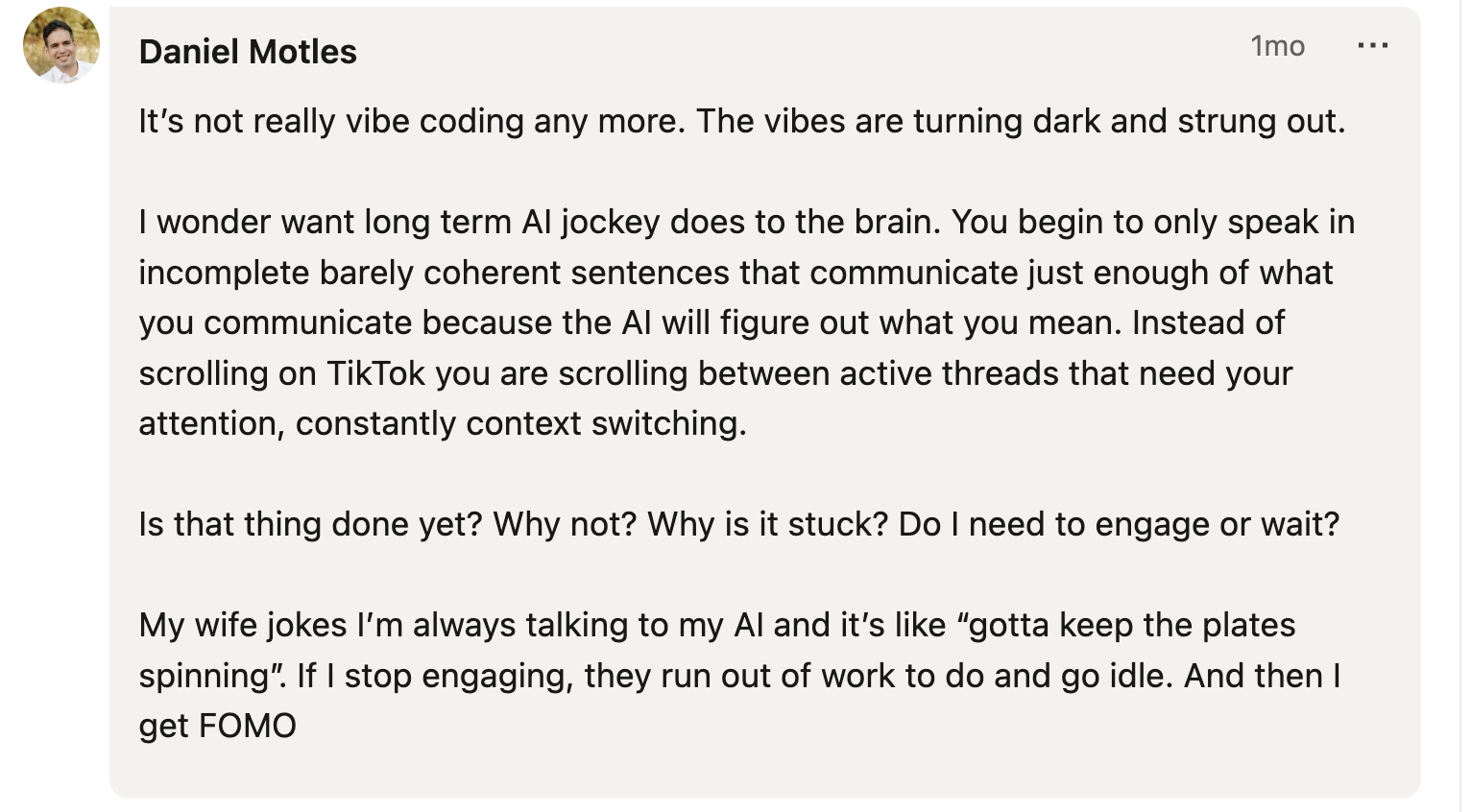
What was most worrying was that the more I chatted with AI, the more I felt a pull towards projects AI is good at, instead of what’s worth working on.
Loops
Just as social media removed the stopping point from entertainment, chat removes the stopping point from productivity. Chat is infinite scroll for work.
If AI writes tens of thousands of lines of code I don’t understand, I need AI to help me debug it, which introduces more surface area for bugs, and creates a game of whack-a-mole.
Or worse, erodes my ability to make decisions without feeling paralyzed.
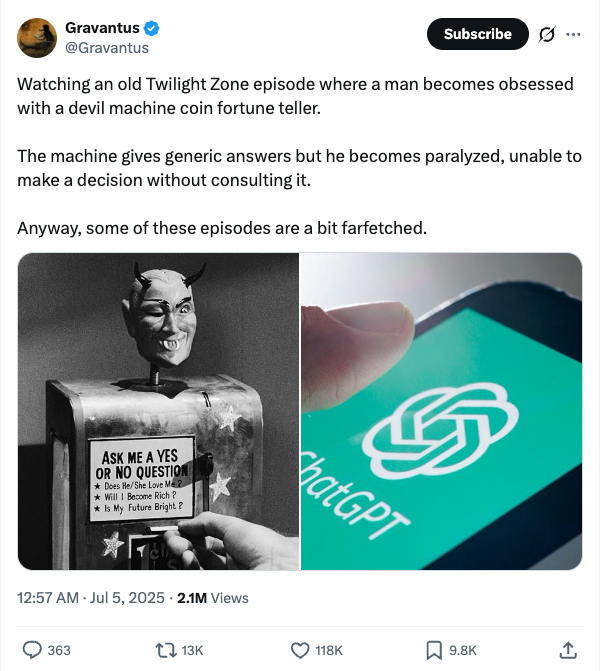
Better models accelerate the problem; compounding screw-ups and encouraging more blind trust.
Break
In 2024, I gave up using (most of) the internet for 5 months.
Throughout the challenge, I jotted down questions about politics, current events, and pop culture I wanted to research once I got back online. At first, the questions gushed out of me, then they turned into a trickle, and then went dry altogether.
At the end of the challenge, I looked at my list, and not a single question felt worth researching. Consumption had been creating the desire to consume.
Last summer, feeling too reliant on chatbots, I went through my last 50 conversations, and realized that none of them needed to be had.
So I went cold turkey, and deleted all my AI tools except Claude Code.
At first, this was alarming, like I was losing a limb. But after a few days, an AI-induced fog started to clear. I felt less paralysis making decisions, and more time in my own rhythm instead of getting sucked into AI’s train of thought.
Delegate
If you’re a manager and every 5 minutes an employee came to you with a question, your brain would explode. The better the employee, the longer they can work unsupervised.
AI has gotten good enough to do hours of work without us, making chat unnecessary for many tasks.
Over the past two months, I’ve recorded 788 voicemails for my agents; while on walks, riding the subway, or wherever I happen to be.
Behind the scenes, Claude Code runs on my laptop to ingest the voicemail transcripts and kick off work; fixing bugs, organizing ideas, starting research.
Later in the day I’ll check Claude’s work, record more thoughts, and go on with my day. More than 90% of my Claude Code sessions happen without me.
I want someone to solve my problems, not distract me with conversations.
Craft
Being an AI babysitter is easy; there’s no rejection and no failures a prompt can’t fix.
Shipping a product worth using is hard. Writing an essay you’re proud of is hard. Maintaining relationships is hard. Closing sales is hard. I’ve found AI can make these more elusive, warping my perspectives and eroding my conviction.
But it can also free us from the mundane and the tedious, leaving us space for the messy, hard work that needs doing.
Related Reading
- Feed the Beast: AI eats software
- Keys to the Castle: rogue agents
- Delegate: run your life with Claude
Subscribe for updates